
For travelers departing from the United States, the simplest way to prepare for Copenhagen public transport is to plan your airport-to-hotel route, budget in Danish kroner (DKK), and arrange a payment method that works overseas. Once you arrive, use the Metro, S-trains, regional trains, buses, and harbor buses with a ticket valid for your route’s zones.
Before leaving the US, download a journey planner, check your credit card’s foreign transaction fees, and make sure you can access mobile tickets without relying on your usual domestic cellular connection. For a short visit, individual tickets or a City Pass are generally easier to understand than a commuter subscription or a pay-as-you-go account. The right choice depends on where you are staying and how often you expect to ride.
This guide explains the network, airport connections, ticket zones, and common mistakes. Prices and app requirements can change; use the official sources linked below to confirm those details before purchasing.

How Copenhagen Public Transport Works
Copenhagen’s public transport network combines several modes under a coordinated, zone-based ticketing system. For ordinary local travel, a valid ticket can cover transfers between participating trains, Metro services, buses, and harbor buses, provided you remain within its geographic and time limits.
The practical benefit is straightforward: you usually choose a ticket for the journey, not a separate ticket for each vehicle.
| Transport type | Most useful for | What to check |
|---|---|---|
| Metro | Airport trips and travel between central neighborhoods | Line, destination, and service notices |
| S-trains, or S-tog | Central Copenhagen and suburban destinations | Line letter and stopping pattern |
| Regional trains | Airport connections, nearby cities, and longer journeys | Destination and ticket coverage |
| City buses | Streets and neighborhoods not directly served by rail | Stop name, direction, and boarding instructions |
| Harbor buses | Selected waterfront journeys | Timetable and whether the stop serves your destination |
Metro lines and major stations
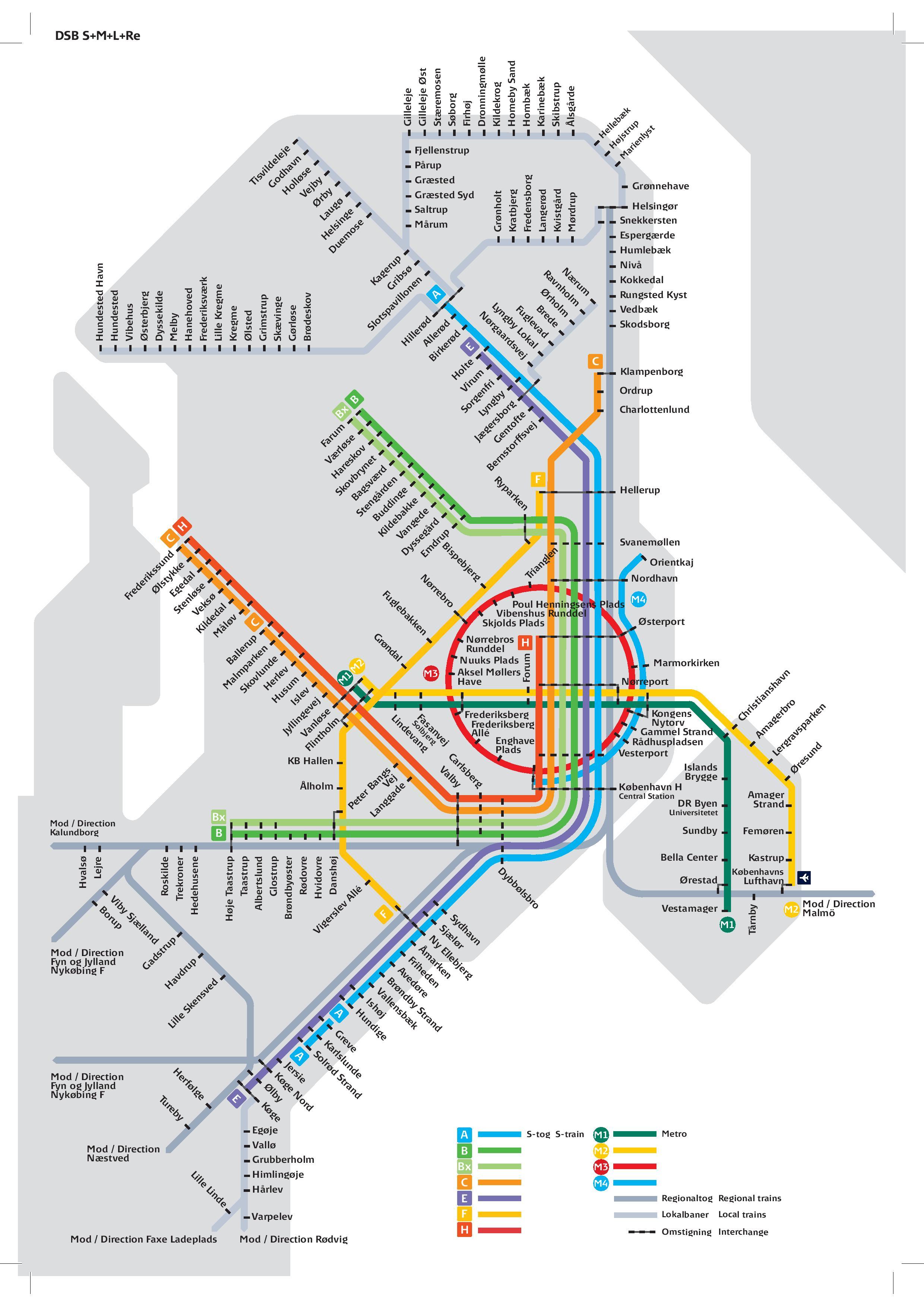
The Metro has four lines:
- M1: Connects Vanløse with Vestamager.
- M2: Connects Vanløse with Copenhagen Airport.
- M3: The City Circle Line, serving central districts on a circular route.
- M4: Connects Orientkaj with København Syd through central Copenhagen.
The Metro normally operates around the clock. Overnight frequency differs from daytime service, and maintenance can cause temporary changes.
Several station names are useful to recognize:
- København H: Copenhagen Central Station.
- Nørreport: A major interchange for Metro, S-trains, and regional trains.
- Kongens Nytorv: An interchange between Metro lines.
- Københavns Lufthavn: Copenhagen Airport.
- København Syd: An interchange in the southern part of the city.
København H and København Syd are different stations. Check the full station name rather than assuming either one means the central station.
Which journey planner should you use?
Use Rejseplanen to compare routes across different operators. Enter your exact starting point, destination, and departure or arrival time.
For a hotel, using the street address is often better than choosing a nearby landmark. A route that looks longer on a map may involve less walking, fewer stairs, or an easier transfer.
Getting From Copenhagen Airport to the City
Choose the airport Metro or train according to your destination—not according to which service appears first when you leave arrivals. Both are accessible from the Terminal 3 area.
Take the Metro for Kongens Nytorv and Nørreport
The airport is served by Metro line M2. It provides direct service to Kongens Nytorv and Nørreport, making it useful for many central hotels.
Typical onboard journeys are approximately 15 minutes to Kongens Nytorv and somewhat longer to Nørreport. Allow additional time for buying a ticket, reaching the platform, waiting, and walking to your accommodation.
If your hotel is near an M3 or M4 station, the planner may suggest a Metro transfer.
Take the train for Copenhagen Central Station
A regional train is usually the straightforward rail choice for København H, or Copenhagen Central Station. The onboard journey is commonly around 15 minutes, although the full airport-to-hotel trip takes longer.
Check the departure display carefully. Airport trains also serve other destinations, including Sweden, so not every departure is heading toward central Copenhagen.
Buy the correct airport ticket
An ordinary single journey between Copenhagen Airport and central Copenhagen generally requires a three-zone ticket. A two-zone ticket is not sufficient for that journey.
A City Pass Small covers the airport because its area includes zones 1–4. That does not mean you need a four-zone single ticket for every airport trip: a pass’s coverage area and a single ticket’s zone calculation are different concepts.
A reliable arrival sequence is:
- Look up the route to your hotel.
- Choose the correct destination station.
- Buy a ticket or pass covering the route.
- Confirm that it is valid before boarding.
- Check the platform display and train destination.
Find airport transport information through Copenhagen Airport.
Understanding Copenhagen Ticket Zones
Copenhagen fares depend on geographic zones, not simply the number of stations or vehicles you use. Your ticket must cover the required journey area and remain valid for the trip you intend to make.
For most visitors, the essential rules are:
- Ordinary local single tickets have a minimum two-zone purchase.
- Airport-to-central-Copenhagen journeys generally require three zones.
- A central-city pass does not automatically cover every attraction in the wider region.
- Transfers do not necessarily require another ticket if the existing ticket covers the route and remains valid.
Do not calculate fares by counting stops
Five stops on one route can require different coverage from five stops on another. Copenhagen’s fare calculation is more complicated than counting station boundaries.
Use the official ticket system or journey planner to calculate the journey. This is especially important for trips outside central Copenhagen.
Check both the geographic and time limits
A ticket can be wrong in two different ways:
- It does not cover the necessary zones.
- Its validity period has ended or has not started.
Before boarding, check the ticket’s start time, expiration time, and coverage. A payment receipt or screenshot of a purchase confirmation is not necessarily a valid travel ticket.
Check day-trip destinations separately
Do not assume a pass that works in downtown Copenhagen also works for trips to Roskilde, Helsingør, or other regional destinations.
Similarly, a journey to Malmö crosses into Sweden and requires a ticket or pass explicitly valid for that cross-border route.
Which Copenhagen Ticket or Pass Should You Buy?
Choose according to your actual itinerary. Individual tickets suit occasional journeys; a City Pass suits repeated travel within its coverage area.
The following table is a decision aid, not a price comparison. Confirm current fares and product terms through the official ticket seller.
| Your travel pattern | Option to consider | Main limitation |
|---|---|---|
| Mostly walking, with only a few rides | Individual tickets | Each journey needs appropriate coverage |
| Frequent travel around central Copenhagen, including the airport | City Pass Small | Limited to zones 1–4 |
| Several trips across a wider part of the capital region | City Pass Large | Check every destination against its coverage |
| Multiple paid attractions plus transport | Copenhagen Card–Discover | Value depends on the attractions you actually visit |
| Longer stay with frequent travel | Current pay-as-you-go or commuter products | Setup and eligibility may be less convenient for a short visit |
City Pass Small versus City Pass Large
City Pass Small covers zones 1–4, including central Copenhagen and the airport. It is the more relevant option for many visitors staying in the city.
City Pass Large covers zones 1–99, offering a substantially wider travel area.
City Pass products have been offered in durations including 24, 48, 72, 96, and 120 hours. Confirm the available durations and activation rules when purchasing.
Do not buy the larger pass merely because it sounds more comprehensive. First check whether your planned destinations require it.
Is a Copenhagen Card worth buying?
Copenhagen Card–Discover combines public transport with admission to participating attractions. It can be useful when your itinerary includes enough paid attractions to justify the combined price.
Compare it against the cost of the transport and attraction tickets you would otherwise purchase:
Hypothetical comparison: If your planned transport costs 250 DKK and your chosen attractions cost 650 DKK, your alternative total is 900 DKK. Compare the relevant card price against 900 DKK—not against the admission value of attractions you will not visit.
Check the exact product. Copenhagen Card–Discover and Copenhagen Card–Hop do not have identical transport benefits. Do not assume every Copenhagen Card includes ordinary public transport.
Use Copenhagen Card’s official website to verify inclusions and activation requirements.
Compare pass duration with your departure time
A timed pass should match your actual travel window. If the product uses rolling hours, a 24-hour pass beginning at noon will not necessarily cover an airport journey late the following afternoon.
Check the start and end times before paying. Buying a pass too early can waste part of its validity period.
How to Buy and Use Copenhagen Transport Tickets
Buy and activate your ticket before boarding unless the specific service’s rules explicitly provide another purchase method. For visitors, station ticket machines are a useful fallback when an app or payment method fails.
Buying at a ticket machine
Ticket machines are available at major rail and Metro stations, including the airport. English-language options help visitors select tickets without needing Danish.
At the machine:
- Select the destination or appropriate ticket product.
- Confirm the passenger category and number of travelers.
- Review the zones and validity.
- Pay using an accepted method.
- Keep the issued ticket available for inspection.
Do not assume every machine accepts cash or every foreign card. If one payment method fails, try another supported method or seek help at an available staffed sales point.
Buying through an app
Rejsebillet is an official ticket-purchasing option. Rejseplanen is primarily a journey planner; finding a route is not the same as buying a ticket.
Before relying on a mobile purchase:
- Check that the app is available to you and accepts your payment method.
- Complete setup before you need to board.
- Confirm that the actual ticket appears.
- Follow the product’s activation instructions.
- Keep your phone charged and the ticket accessible.
Denmark’s Rejsekort products and payment systems are changing. Older travel guides may describe physical-card or account procedures that no longer apply. Check Rejsekort’s official information before using those instructions.
Do not assume a bank-card tap purchases your fare
Copenhagen should not be treated as a universal “tap your credit card and ride” system. Your bank card may pay for a ticket at a machine without functioning as the travel ticket itself.
Likewise, instructions for checking in and out apply only to products that require those actions. Follow the rules for the specific ticket or account you purchase.
Ticket inspection and fines
Inspectors check tickets on the network. The absence of a fare gate does not mean travel is free.
You must be able to present a valid ticket when asked. Incorrect zones, missing activation, or an inaccessible phone ticket can create problems even if you intended to pay. Check the operator’s current control-fee rules rather than relying on fine amounts quoted in an old article.

Riding the Metro, Trains, Buses, and Harbor Buses
Check the line, direction, and stopping pattern before boarding. Having the correct ticket does not guarantee that the vehicle is traveling toward your destination.
Metro and trains
Metro platforms show the line and destination. On the circular M3 line, either direction may eventually reach your stop, but one can take substantially longer.
For S-trains, use the line letter and destination shown in your planned route. Regional trains can have different stopping patterns, so confirm that your station appears on the departure information.
Let passengers exit before boarding, keep luggage out of aisles, and avoid blocking doors.
City buses
Use the exact stop and direction shown in the journey planner. Stops on opposite sides of the road usually serve opposite directions, and nearby stops can have different names.
Follow the vehicle’s boarding signs and use the stop-request button when needed. Boarding arrangements can vary, so do not assume every bus follows the same front-door procedure.
Harbor buses
Harbor buses are scheduled public transport boats with designated stops. They can be useful for waterfront journeys, but they are not interchangeable with sightseeing cruises.
Ordinary integrated tickets generally apply when valid for the journey. Check the timetable, operating notices, and destination before treating a harbor bus as part of a time-sensitive route.

Accessibility, Children, Luggage, and Bicycles
Travel requirements can change the best route or ticket. Check these details before departure rather than trying to resolve them at the platform.
Step-free travel
Metro stations are designed with elevators, but an elevator outage can make a planned route unsuitable. Step-free access does not establish that every transfer or street-level approach is equally convenient.
For wheelchair users and travelers who cannot use stairs:
- Check lift availability.
- Review the interchange rather than only the starting and ending stations.
- Allow extra transfer time.
- Check whether train assistance must be booked in advance.
Consult the relevant operator when you need boarding assistance or a specific accessibility accommodation.
Traveling with children
Child fares and accompanying-child rules depend on age, ticket type, and the fare system involved.
Do not assume the Copenhagen Card’s child policy is the same as an ordinary transport ticket’s policy. Check:
- The child’s age on the travel date.
- How many children may accompany the paying traveler.
- Whether a separate child ticket or pass is required.
Luggage and strollers
Normal travel luggage is generally practical on Copenhagen public transport, but space can be limited during busy periods. Use designated areas where available and keep doors, aisles, and wheelchair spaces clear.
A slightly longer route with fewer transfers may be easier than the quickest route when traveling with large suitcases or a stroller.
Bicycles
Bicycle rules differ between the Metro, S-trains, regional trains, and buses. Charges, capacity restrictions, and peak-period rules can also differ.
Check the specific operator’s policy before bringing a bicycle. Permission on one part of the network does not establish permission on the next.
Common Copenhagen Public Transport Mistakes
Most avoidable problems involve the wrong ticket, wrong destination, or an assumption carried over from another transport system.
| Mistake | Why it causes trouble | What to do instead |
|---|---|---|
| Buying two zones for the airport-to-center journey | Coverage is insufficient | Select the airport journey or a covering pass |
| Treating a route search as a ticket purchase | No valid ticket has been issued | Open and verify the purchased ticket |
| Assuming every pass covers regional day trips | Coverage areas differ | Check the destination before buying |
| Boarding any train at the airport | Trains serve different directions | Read the destination display |
| Confusing København H with København Syd | They are separate stations | Match the full station name |
| Letting a phone battery die | A mobile ticket may become inaccessible | Carry a charger and follow display requirements |
| Following old Rejsekort instructions | Products and procedures can change | Use current official guidance |
| Assuming a Copenhagen pass covers Malmö | The journey crosses a national border | Buy explicitly valid cross-border coverage |
If a disruption changes your route, consult the official planner and operator notices. A valid ticket does not mean every replacement route or service is automatically suitable; check any special instructions associated with the disruption.

Frequently Asked Questions
Can I use Copenhagen public transport without mobile data?
Yes, paper tickets provide an alternative to app-based travel. For mobile tickets, check whether the particular product remains displayable offline. Save route information before leaving Wi-Fi, but do not assume a screenshot can replace the ticket.
Is there a reduced fare for American seniors?
Do not assume that US senior status qualifies you for a Danish discount. Some concessions depend on the product, documentation, or eligibility rules. Check the specific fare before purchasing a reduced ticket.
What happens if I lose something on public transport?
Contact the operator responsible for the vehicle where you likely left the item. Note the line, direction, approximate time, and boarding or exit station. Rejseplanen can help identify the service, but it is not a single lost-property office for the entire network.
Can I get a refund for an unused ticket?
Refund rules depend on the product, seller, and whether the ticket has been activated. Check the terms before buying a long-duration pass. Do not assume that leaving Copenhagen early creates a right to a partial refund.
What if I receive a ticket fine that I believe is incorrect?
Follow the issuing operator’s appeal process and deadline. Keep the ticket, purchase receipt, inspection notice, and relevant journey details. Evidence of payment can help explain the situation, but it does not necessarily prove the ticket was valid for that journey.
Official Sources and Research Transparency
Use official sources to verify details that can change before your trip:
- Rejseplanen: Journey planning and service information.
- Copenhagen Metro: Metro lines, operating information, and passenger guidance.
- DSB: Train services, ticket information, and travel conditions.
- Rejsekort: Current payment products and ticketing information.
- Copenhagen Airport: Airport ground-transport guidance.
- Copenhagen Card: Card coverage, participating attractions, and product terms.
Research limitation: Live browsing was unavailable for this article. These official source destinations were not inspected during drafting, and no competitor pages or live search results were reviewed. Exact current fares, app compatibility, discount eligibility, and temporary service changes are therefore not presented as verified current facts.
Next-question gap map
The following questions are inferred from the traveler’s task, not presented as observed search demand. Competitor coverage remains not checked.
| Question | Reader stage and basis | Reader benefit | Evidence needed or relevant source | Priority and placement |
|---|---|---|---|---|
| Will my US payment method work? | Before travel; inferred from overseas ticket purchasing | Avoids an arrival-time purchase failure | Current app terms, seller payment rules, and card issuer | High; ticket-buying section |
| Does my pass cover both the airport and a day trip? | Planning; inferred from zone-based coverage | Prevents buying insufficient coverage | Official pass map and destination fare calculation | High; zones and passes |
| What if my mobile ticket cannot be displayed? | During travel; inferred from inspection requirements | Reduces ticket-inspection problems | Current seller and operator conditions | High; ticket use and FAQ |
| Can I complete the route without stairs? | Before departure; inferred from accessibility needs | Identifies unusable transfers | Operator accessibility guidance and lift notices | High; accessibility section |
| Does the pass cover Sweden? | Planning; inferred from a likely cross-border excursion | Prevents invalid travel beyond the pass area | Cross-border ticket conditions | Medium; zones section |

Conclusion
For most US visitors, the practical approach is to plan journeys with Rejseplanen, buy either individual tickets or a City Pass that matches the itinerary, and verify the ticket before boarding.
Start with your airport-to-hotel journey. Then check whether your sightseeing stays within zones 1–4 or requires wider coverage. Those two decisions will resolve most ticket choices—and help you avoid paying for a pass you do not need.