
I like to understand the local road rules before booking a rental car. Driving In Denmark is generally straightforward for US visitors: vehicles travel on the right, but road signs follow European conventions and speed limits are shown in kilometres per hour.
A valid US driver’s license is generally sufficient for a short tourist visit, but I recommend confirming current requirements through official Danish guidance and your rental company before booking. I’d also check which documents you must carry and review right-of-way rules, bicycle traffic, and parking controls rather than assuming they work exactly as they do at home.
Your route matters, too. Before entering an urban low-emission zone, check your vehicle’s eligibility and any applicable registration requirements. If you plan to cross the Storebælt or Øresund bridges, review current tolls and payment options—and confirm your rental company’s cross-border terms if you’re continuing into Sweden.
In this guide, I explain the practical adjustments that help American drivers prepare for Danish roads and avoid preventable surprises..
Can Americans Drive in Denmark?
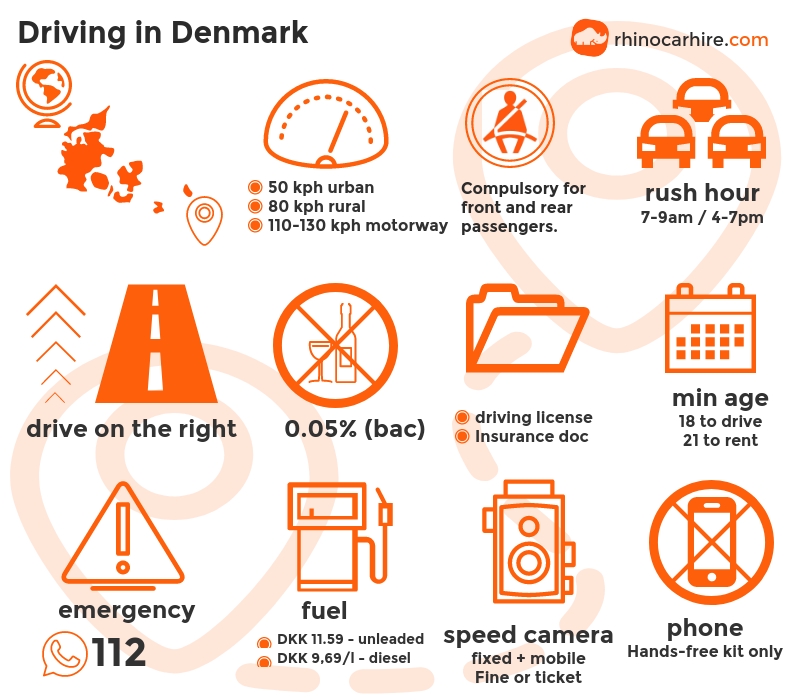
Yes. U.S. visitors can generally drive in Denmark with a valid state-issued driver’s license, provided they meet the rental company’s age and documentation requirements. Denmark recognizes many foreign licenses for temporary visits, but the physical license should be valid, readable, and written in the Latin alphabet.
An International Driving Permit, or IDP, is not normally a substitute for your U.S. license. It serves as a translation and may be requested by a rental company, insurer, or local authority. Because requirements can vary by rental company and by the issuing U.S. state, confirm the policy before departure.
Documents to carry
A U.S. driver should normally have:
- A valid U.S. driver’s license
- Passport or other accepted travel identification
- Rental agreement, if using a rental car
- Proof of insurance or rental-car coverage
- Vehicle registration documents if driving a privately owned vehicle
- An IDP if the rental company requests one or if the license is difficult to interpret internationally
If you are driving a vehicle registered outside Denmark, keep the registration and insurance documents in the vehicle. Drivers should also know how their U.S. auto insurance, credit-card coverage, or travel policy applies outside the United States. Many policies exclude foreign rental vehicles or provide only limited coverage.
Minimum driving age
The legal driving age for a standard passenger vehicle in Denmark is generally 18. Rental companies may impose higher minimum ages, commonly 21 or 25, and may add a young-driver surcharge. Some companies restrict larger vehicles, luxury models, or vans to older drivers.
Always check:
- Minimum rental age
- Young-driver fees
- Required license-holding period
- Deposit and credit-card requirements
- Cross-border travel restrictions
- One-way rental fees
- Whether additional drivers must be listed
A rental company’s contract can be stricter than the general legal requirement.
Danish Road Rules Americans Need to Know
Denmark uses right-hand traffic, but several rules may feel different to U.S. drivers. The most important are metric speed limits, right-of-way conventions, daytime lighting, strict alcohol limits, and the presence of bicycles on nearly every urban road.
Speed limits in Denmark
Danish speed limits are posted in kilometers per hour (km/h), not miles per hour (mph). Common maximum limits for passenger cars are:
| Road or area | Common limit | Approximate miles per hour |
|---|---|---|
| Built-up areas | 50 km/h | 31 mph |
| Rural roads | 80 km/h | 50 mph |
| Motorways | 130 km/h where posted | 81 mph |
These are general limits, not guarantees. Signs may impose lower limits because of construction, weather, intersections, urban design, or local traffic conditions. A lower posted speed limit always takes priority.
Useful conversions include:
- 50 km/h ≈ 31 mph
- 80 km/h ≈ 50 mph
- 100 km/h ≈ 62 mph
- 110 km/h ≈ 68 mph
- 130 km/h ≈ 81 mph
Rental cars normally display speed in kilometers per hour. Do not rely on a U.S. vehicle’s mile-per-hour display if you bring your own car unless the instrument cluster clearly provides both units.
Right-of-way and priority to the right
At an intersection without traffic lights, yield signs, or priority-road signs, Denmark may apply “priority to the right.” This means you may need to yield to traffic approaching from your right, even when the road appears larger or more heavily traveled.
Do not assume that the vehicle on the wider road automatically has priority. Look for:
- Yield signs
- Stop signs
- Triangular road markings
- Yellow-and-white priority markings
- Traffic lights
- Signs indicating a priority road
- Changes in curb or lane markings
When the rule is unclear, reduce speed and be prepared to yield. Danish intersections can be compact, and cyclists may approach from directions that are unfamiliar to U.S. drivers.
Roundabouts
At a typical Danish roundabout, traffic already circulating generally has priority. Slow before entering, yield to vehicles in the roundabout, and signal when exiting.
For multilane roundabouts:
- Choose the appropriate lane before entering.
- Follow directional arrows and lane markings.
- Check mirrors and blind spots before changing lanes.
- Signal your exit clearly.
- Watch for bicycles using a parallel cycle track or marked crossing.
Do not treat a roundabout like a four-way U.S. intersection. The correct lane depends on the road markings and the exit you intend to take.
Seat belts and child restraints
Seat belts are required for occupants in vehicles equipped with them. Children must use an appropriate child restraint based on their size and the applicable Danish rules.
A child under 135 centimeters in height generally needs an approved child restraint rather than relying only on the vehicle’s adult seat belt. Rental companies often offer child seats, but availability may be limited, and the seat may not be installed correctly for your child’s age or size.
Confirm in advance:
- The child’s height and weight category
- Whether a rear-facing seat is available
- Whether the seat is compatible with the rental car
- Whether the company permits customers to install their own seat
- Whether the vehicle has the necessary ISOFIX anchors
Headlights and daytime driving
Vehicles are generally required to use appropriate lights during daytime driving. Rental cars commonly activate daytime running lights automatically, but drivers should verify that the rear lights are illuminated when visibility is poor.
Use dipped headlights in conditions such as:
- Darkness
- Heavy rain
- Fog
- Snow
- Tunnels
- Reduced visibility
- Road sections where signs require them
Automatic lighting systems do not remove the driver’s responsibility to select the correct lights.
Mobile phones and distracted driving
Do not hold or operate a mobile phone while driving. Use a legal hands-free system only when it can be operated without taking your attention from traffic.
Program navigation before moving, and stop in a safe location if you need to enter a destination or read a message. Danish roads often require close attention to cyclists, signs, narrow lanes, and changing priority rules.
Alcohol and drug-impaired driving
Denmark has a low legal blood-alcohol limit compared with many U.S. states. The commonly cited limit for ordinary drivers is 0.5 grams per liter of blood, equivalent to a 0.05% blood-alcohol concentration.
Do not use the legal limit as a drinking target. Alcohol affects reaction time and judgment before a driver reaches the legal threshold. The safest choice is zero alcohol when driving.
Rules can be stricter for certain drivers or circumstances, and penalties may include fines, driving disqualification, or criminal consequences. Never drive after using alcohol, cannabis, sedating medication, or another substance that could impair attention or coordination.
Driving in Denmark With Bicycles, Pedestrians, and Public Transport
The greatest practical challenge for many U.S. visitors is not the highway system but the interaction between cars, bicycles, pedestrians, buses, and light rail in urban areas.
Bicycles have a strong presence
Copenhagen and other Danish cities have extensive cycling infrastructure. A bicycle may travel:
- In a dedicated cycle lane beside the road
- On a separated cycle track
- Across a marked bicycle crossing
- Alongside a turning lane
- Through an intersection where the cyclist has a separate signal
Check the cycle lane before turning or opening a car door. A driver turning across a bicycle lane must yield when required by signs, signals, and road markings.
Before making a right turn:
- Check the interior and side mirrors.
- Look over your shoulder for cyclists.
- Signal early.
- Move only when the bicycle lane and crossing are clear.
- Complete the turn slowly.
A common mistake is checking only for cars. A cyclist can be close to the vehicle’s passenger side and may be hidden in a blind spot.
Passing cyclists
Give cyclists generous clearance and reduce speed when passing. Do not pass if oncoming traffic, parked cars, roadworks, or a narrow lane leaves insufficient space. Wait until you can pass without forcing the cyclist toward a curb, parked vehicle, or obstacle.
The precise legal requirements can depend on the road layout and circumstances, so follow Danish signs and markings rather than relying on a single assumed distance.
Pedestrian crossings
Yield at marked pedestrian crossings as required and approach them slowly when people are waiting or crossing. Do not overtake another vehicle that has stopped at a crossing. A pedestrian may be hidden from view by the stopped vehicle.
In central Copenhagen and other busy areas, pedestrians may enter the roadway near bicycle lanes, bus stops, and intersections. Keep your speed low enough to stop safely.
Buses and light rail
Buses may pull away from stops in urban areas, and some cities have trams or light-rail vehicles. Watch for:
- Bus-only lanes
- Transit signals
- Passengers crossing toward a bus
- Tracks embedded in the road
- Restrictions on turning across transit lanes
- Vehicles approaching from a separate rail corridor
When road markings are unfamiliar, follow the lane arrows and signs instead of copying the vehicle ahead.

Danish Road Signs, Lane Markings, and Navigation
Danish signs generally follow the European sign system. Many signs use symbols rather than English text, so recognizing shapes and colors is more useful than searching for a word-for-word translation.
Important sign types
- Red-bordered circular signs: Restrictions or prohibitions
- Blue circular signs: Mandatory actions, such as required directions
- Red-bordered triangular signs: Warnings
- Blue rectangular signs: Information or directions
- Inverted red-and-white triangle: Yield
- Red octagonal sign: Stop
- Yellow town signs: Built-up-area entry or exit information
Speed-limit signs are typically circular with a red border and a number in kilometers per hour.
Road markings
Pay attention to:
- Solid center lines
- Broken lane lines
- Bicycle-lane markings
- Bus lanes
- Directional arrows
- Stop lines
- Yield triangles
- Yellow temporary markings around construction
Temporary yellow markings may override ordinary white markings in roadwork areas. Follow the temporary layout even when it differs from the normal lane arrangement.
Navigation and map settings
Set your navigation app to display:
- Kilometers and kilometers per hour
- Danish road names
- Toll roads or toll-bridge warnings
- Low-emission or environmental-zone restrictions
- Vehicle dimensions, if driving a camper or large van
Do not assume the fastest route is the easiest route. A navigation app may direct you through a city center with bicycle lanes, restricted turns, paid parking, or an environmental zone.
Before departing, check the complete route rather than only the destination. This is especially useful for trips involving Copenhagen, Aarhus, Odense, Aalborg, or a bridge crossing.

Tolls, Ferries, and Environmental Zones
Denmark does not have a general motorway toll system for ordinary passenger cars, but some major bridges and ferries charge separately. Environmental-zone rules can also affect whether a vehicle may enter certain urban areas.
Storebælt and Øresund bridge tolls
The two major tolled crossings are:
- Storebælt Bridge: Connects Zealand and Funen
- Øresund Bridge: Connects Denmark and Sweden
The price depends on factors such as:
- Vehicle type
- Vehicle height and length
- Payment method
- Prepayment or electronic agreement
- Travel date and current pricing
Check the official bridge operator before travel because rates and payment arrangements can change. A rental car may have a transponder or electronic toll arrangement, but you should ask the rental company how charges are billed.
If you cross into Sweden, verify that your rental agreement allows international travel and determine whether additional insurance or documentation is required.
Ferries
Ferries connect Danish islands and provide routes to nearby countries. Reservations may be advisable during holidays and peak travel periods. Confirm:
- Vehicle dimensions
- Check-in deadline
- Passenger requirements
- Cancellation rules
- Whether the ticket covers the driver and passengers
- Whether cross-border travel is permitted by the rental agreement
Allow extra time at the terminal. Missing a vehicle check-in deadline can require a new booking.
Environmental zones
Several Danish cities operate environmental or low-emission zones. These rules primarily affect older diesel vehicles and may require the vehicle to meet a specified emissions standard or have an approved particulate filter.
Potentially affected areas have included parts of:
- Copenhagen
- Frederiksberg
- Aarhus
- Odense
- Aalborg
The exact requirements can change. Before entering an environmental zone:
- Identify whether your route enters the zone.
- Confirm the vehicle’s fuel type and emissions classification.
- Check whether a diesel particulate filter is recorded or required.
- Register the vehicle if the official system requires registration for foreign vehicles.
- Save proof of registration or compliance.
Do not assume a rental company has handled this automatically. Ask specifically whether the vehicle may enter the intended city zone and whether any foreign-vehicle registration is necessary.
Fines for noncompliance can be substantial, and a navigation app may not warn you reliably.
Parking in Denmark
Parking rules are closely controlled in Danish cities. A legal parking space may require payment, a parking disc, a digital registration, or a combination of conditions.
Common parking controls
You may encounter:
- Pay-and-display machines
- Mobile parking apps
- License-plate-based payment
- Time-limited parking
- Resident-only spaces
- Parking discs
- Restricted loading areas
- Blue parking zones
- No-parking and no-stopping signs
Read the entire sign, including supplementary panels. A sign may apply only during certain hours, to a particular vehicle category, or on one side of the road.
Parking discs
A parking disc records your arrival time in areas where parking is free but time-limited. Rental vehicles may include a disc, but do not assume one is present or correctly set.
If a parking disc is required:
- Park in a permitted space.
- Set the disc to the correct arrival time according to Danish rules.
- Display it where it can be seen through the windshield.
- Leave before the posted time limit expires.
Do not use a U.S. handwritten note as a substitute unless the sign specifically allows it.
Paid parking
Some Danish parking systems require you to enter the vehicle’s license plate into a machine or app. Keep the rental vehicle’s plate number available. Photographing the plate or writing it down before walking away can prevent errors.
Check whether:
- Payment is required immediately
- The first minutes are free but still require registration
- Payment continues automatically
- The zone changes at specific times
- The app is available to visitors
- A receipt must be displayed
A parking ticket is not necessarily a traffic ticket. It may be issued by a private parking operator under separate terms, but it can still create a financial obligation under the rental contract.
Avoiding common parking mistakes
Do not park:
- On a cycle track
- In a bus lane
- In front of a driveway
- Near an intersection where restrictions apply
- In a marked loading zone without authorization
- In a space reserved for residents or disabled drivers
- In a restricted urban area without checking the sign
When in doubt, use an official public garage and retain the payment receipt.

Equipment, Fuel, and Rental-Car Considerations
A rental car in Denmark should be supplied with required safety equipment, but inspect the vehicle before leaving the lot.
Safety equipment
A warning triangle is generally required equipment in vehicles. Check that it is present and accessible. A reflective vest is useful, particularly if you must exit the vehicle on a motorway or at night, although equipment requirements can differ by vehicle and situation.
Before driving away, verify:
- Warning triangle
- Spare tire or tire-repair kit
- Reflective vest, if supplied
- First-aid kit, if supplied
- Vehicle registration documents
- Damage report
- Fuel type
- Emergency contact number
Photograph existing damage and make sure it is listed on the rental inspection record.
Fuel
European rental cars may use:
- Petrol, also called gasoline
- Diesel
- Electric charging
- Plug-in hybrid fuel and charging
The fuel filler cap or rental documents should identify the correct fuel. Do not rely solely on color coding, because colors can vary between countries and fuel stations.
If you use an electric vehicle, plan charging stops in advance. Check whether the rental company provides a charging card, app access, cable, and instructions for returning the vehicle with a specified battery level.
Automatic versus manual transmission
Manual transmissions are common in Europe, while automatic vehicles may cost more and have limited availability. Confirm the transmission type before booking if you are not comfortable driving a manual car.
For a manual rental, remember that the clutch, gear selector, and parking procedure may differ from what you use in the United States. Practice in the rental lot before entering city traffic.
Winter driving
Denmark can experience ice, snow, wind, and short daylight hours. Winter tires are not automatically required in every ordinary winter situation in the same way they are in some U.S. states, but tires must be suitable for the conditions and comply with Danish requirements.
If traveling between November and March, ask the rental company:
- Whether the car has winter or all-season tires
- Whether the tires meet current legal requirements
- Whether snow chains are permitted or supplied
- How roadside assistance works in severe weather
Reduce speed on icy or wet roads even when the posted limit remains higher. Bridges and exposed roads may freeze before surrounding pavement.

What to Do After a Crash or Breakdown
After a collision, prioritize safety and follow the proper reporting process rather than negotiating fault at the roadside.
If there are injuries or immediate danger
- Stop and turn on hazard lights.
- Move to a safe location if the vehicle can be moved without creating additional danger.
- Call 112 for emergencies involving injuries, danger, fire, or a serious crash.
- Use a warning triangle if you can place it safely.
- Do not stand in a live motorway lane.
On a motorway, leave the vehicle from the side away from traffic when possible and move behind a barrier if safe.
If the crash is minor
Exchange information with the other driver, including:
- Name
- Address
- Phone number
- Vehicle registration
- Insurance details
- Rental-company information
Photograph the vehicles, road position, signs, lane markings, and visible damage. Record the time and location. Do not sign a document you do not understand.
Notify the rental company as soon as possible, even if the damage appears minor. Failure to report an incident can affect insurance coverage or the company’s damage process.
If the vehicle breaks down
Contact the rental company’s roadside-assistance number. Do not arrange expensive repairs independently unless the rental company authorizes them.
Provide:
- Exact location
- Road number or nearest exit
- Direction of travel
- Vehicle registration
- Warning-light information
- Whether passengers are in a safe location
If the car displays a serious warning light, unusual smoke, overheating, brake failure, or loss of steering control, stop driving and request assistance.
:max_bytes(150000):strip_icc()/tilt-shift-image-of-vehicles-on-highway-501880891-5c002501c9e77c00514251b0.jpg "Equipment, Fuel, and Rental-Car Considerations")
Practical Driving Itinerary and Cost Planning
Driving is useful for exploring coastal areas, rural regions, and multiple islands, but it is not always the most efficient way to travel within Copenhagen or another major city.
When a rental car makes sense
A car is often useful when you plan to:
- Visit several towns outside the main rail corridors
- Explore rural areas or coastlines
- Carry substantial luggage or equipment
- Travel with young children
- Visit attractions with limited public transportation
- Combine Denmark with a road trip through neighboring countries
Public transportation may be more convenient for central Copenhagen, where parking is expensive and bicycle traffic is heavy.
Example travel calculation
A hypothetical 200-kilometer rural trip at an average moving speed of 80 km/h would take at least 2.5 hours of driving time:
[
200 \text{ km} \div 80 \text{ km/h} = 2.5 \text{ hours}
]
The actual journey may take longer because of towns, traffic, fuel stops, ferry schedules, bridge crossings, and sightseeing. A route planner’s estimated time should not be treated as a guaranteed arrival time.
Costs to budget
Include:
- Rental rate
- Insurance and excess reduction
- Fuel or charging
- Parking
- Bridge tolls
- Ferries
- Additional driver fees
- Child seats
- Young-driver charges
- Possible environmental-zone compliance costs
- Cross-border fees
Ask the rental company whether bridge tolls, parking charges, and traffic penalties are billed directly to your card with an administrative fee.
Common Mistakes U.S. Drivers Make in Denmark
The following errors are avoidable with a short pre-trip review:
Confusing kilometers with miles
A speed of 80 km/h is about 50 mph—not 80 mph. Confirm that the vehicle’s display and navigation app use kilometers.
Turning without checking the bicycle lane
A right turn can cross a cycle lane or bicycle crossing. Check the passenger side carefully before turning.
Assuming right-of-way works like in the United States
Priority may belong to traffic approaching from the right at an unmarked intersection. Look for signs and road markings before proceeding.
Entering a restricted environmental zone
Older diesel vehicles may require registration or may not qualify. Verify the city rules and the vehicle’s status before entering.
Treating parking as informal
A space that looks free may require a parking disc, payment, digital registration, or a resident permit. Read the complete sign.
Using the legal alcohol limit as a target
The limit is low, enforcement can be strict, and impairment varies by person. Use zero alcohol when driving.
Relying on a navigation app alone
Apps may not accurately reflect temporary closures, bicycle-only routes, parking restrictions, environmental zones, or rental-car toll procedures. Combine navigation with road signs.
Key Takeaways
- U.S. visitors can generally drive in Denmark with a valid driver’s license, but rental-company rules may differ.
- Denmark drives on the right and uses kilometers per hour.
- Common limits are 50 km/h in towns, 80 km/h on many rural roads, and up to 130 km/h on selected motorways.
- Bicycles have priority protections and are a major factor in urban driving.
- Check for environmental-zone requirements before entering larger cities.
- Storebælt and Øresund crossings charge separate tolls.
- Parking signs and payment requirements must be followed precisely.
- Call 112 for emergencies involving injuries or immediate danger.
- Verify current rules with official Danish sources before travel because traffic regulations, bridge prices, environmental-zone requirements, and rental policies can change.
Frequently Asked Questions
Is an International Driving Permit required for Americans in Denmark?
Usually not for a clearly written, valid U.S. driver’s license used during a short visit. However, a rental company may request an IDP, and an IDP can help translate license information. Carry it together with—not instead of—your U.S. license when required.
Can I use my U.S. driver’s license to rent a car in Denmark?
Generally, yes, if the license is valid and you meet the rental company’s age and documentation rules. Confirm the company’s policy before arrival, especially if your license is temporary, damaged, not written in English, or uses unusual formats.
Is driving in Copenhagen difficult?
It is manageable but can be demanding for unfamiliar drivers because of bicycle lanes, one-way streets, restricted turns, pedestrians, buses, paid parking, and environmental-zone rules. For a central Copenhagen stay, public transportation may be easier than renting a car.
Are Danish motorways toll roads?
Most Danish roads and motorways do not use general toll booths. However, the Storebælt and Øresund bridges charge tolls, and ferries have separate fares.
Do I need winter tires in Denmark?
Winter tire requirements depend on current Danish rules and road conditions. Even when a specific winter-tire requirement does not apply, tires must be suitable and legal for the conditions. Ask the rental company what tires are installed before traveling in winter.
What should I do if I receive a parking or traffic fine in a rental car?
Do not ignore it. Contact the rental company and review the notice. The rental company may charge the fine to your payment card and may add an administration fee. If you believe the notice is incorrect, follow the issuing authority’s appeal process.
Official Sources to Check Before Driving
Rules and charges can change, so confirm details shortly before departure using official sources:
- Danish Road Traffic Authority
- Danish Road Directorate
- Danish environmental-zone information
- Storebælt Bridge
- Øresund Bridge
- Danish Emergency Services
Conclusion
Driving in Denmark is practical for U.S. travelers who prepare for metric speed limits, bicycle-heavy cities, right-of-way differences, strict parking controls, and bridge or environmental-zone charges. Before collecting a rental car, confirm the license requirements, inspect the vehicle, set navigation to kilometers, and review the route for tolls and restricted areas.
For the safest trip, drive defensively, give cyclists and pedestrians extra space, follow posted signs instead of assumptions, and verify current requirements through Danish authorities and your rental company.